Thursday, February 17, 2011

A shooting star.

GUESS WHAT!
A "shooting star" is not a shooting star! It's actually a broken fragment of a comet (Ice, dust, and rock,) that travels through space, orbiting the sun. When this piece of debris is in outer space it is called a meteoroid. Gravity will eventually pull the meteoroid into Earth's atmosphere, making it a meteor. As these fragments of rock fall into Earth's atmosphere, they will experience a buildup of frictional heat. The heat makes the particles of the meteor glow brightly as it continues to fall. Most meteors will burn up before they hit the Earth, but if they are large enough and make it to the ground, they are called a meteorite. When you are staring into the beautiful night sky and notice a streak of light pass by, you are looking at a "shooting star."


The largest meteorite was discovered in 1920 by a farmer in Namibia. It is nine feet long, nine feet wide, and three feet thick. "Hoba" weighs 66 tonnes, and is composed of 84% iron, 16% nickel. It currently resides in its original location of discovery.

Friday, February 11, 2011

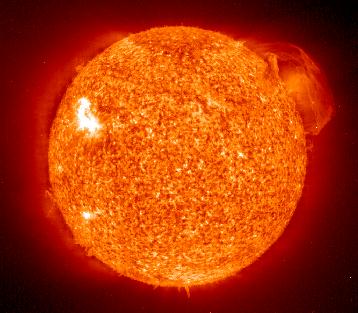
The Sun.

98% of our total solar systems mass is taken up by the Sun, making it the largest object in the solar system. The Sun is around 70% Hydrogen, and 28% Helium. The last 2% is made up of "metals". This can slowly change over time as the Sun converts Hydrogen to Helium in its core (The inner 25% of its radius). The Sun produces power by Nuclear Fussion Reactions.


The Sun is approximately 4.5 billion years old, and has used up to half of the Hydrogen in its core. For the next 5 billions years it will continue to radiate, and it's luminosity will double in that time. Eventually, the Sun will run out of Hydrogen fuel and be forced into radical changes. This means that through commonplace by stellar standards, it will result in the total destruction of the Earth.

Thursday, February 3, 2011

R136a1

R136a1 is a newly discovered star, founded by a group of British astronomers. This star is outside of the milky way in star cluster R136. It is believed that R136 contains tens of thousands of stars within a few light-years of space. Hundreds of it's stars, which are rare and massive, are so bright that any planet orbiting a star in the middle of it's cluster does not experience darkness at night. R136a1's mass is said to be around 265 times larger than the sun. Even though this star is only a little over a million years old, it has already lost around a fifth of it's initial mass.


As of July 2010, this star has the highest known stellar luminosity. The temperature at the surface of this star reaches up to 50 thousand degress celsius, which is almost 8 times more heat than the sun. It is ten million times brighter than the sun, and 165,000 light-years away from Earth. Sadly, this star will only live for approximatlely 3 million years.


http://www.theepochtimes.com/n2/content/view/39587/

Thursday, January 20, 2011

The Moon and the Bay of Fundy.

What causes a tide?
Gravitational forces of the moon and sun, and the spinning rotation of the earth, make tides rise and fall by tugging on the surface of the ocean. Eventually the surface mounds up and outward towards the moon. Along with daily movements of the moon, monthly lunar cycles are known to impact tides. While the moon pulls the water towards itself, it creates a lunar tide. This is a bulge on the surface of the ocean closest to the moon. As the moon rotates around the earth, the bulges shift, causing a change in the water levels.

Why do I care?
Chances are highly likely that you, the reader, live within driving distance of the Bay of Fundy. If you do not know where it is, here is a picture!

The Bay of Fundy is known to have the highest tides in the world. The average tidal range of oceans around the world is 3 ft. With the amount of water, the depth, and its unique shape causing resonance, these tides can range between 11-53 ft! The earth has a weak control over water because it is a liquid substance that is free to shift as it pleases. It is extraordinary how something that is 384,403 kilometers away can affect the world on a daily basis. That is why you care.

Monday, January 10, 2011

The Universe and how it came to be.

The Big Bang theory explains how our universe came to be. It is said that it began as a small, hot, and dense, lets say "thing",  over 13.7 billion years ago. It has expanded and cooled to what we know of it today. I find it neat to learn about the universe, and it is surprising when you notice just how small we actually are in relation to it, but what was there before this massive mess appeared? What made the universe? It is impossible for us to find this out with the technology today, so for now, we will consider a possibility.

The first thing I think of when I imagine the orgin of the universe is the orgin of me. I know that I came from "stuff" in the solar system, so is it not possible that the universe came from "stuff" as well? It could simply be another universe in a local cluster of universe's. If this were true, we'd be left wondering where those universes came from, and the questions would go on forever. I'm sure many scientists have tried to discover the explanation around the coming of the universe, but it is gonna take ALOT of time and tests to find the true answer. Its quite possible that this information could never be found, and civilization would end up extinct without an explanation as to where everything came from.